By Cde Bekezela Mkonto KaMthwakazi
Last Monday the ZBC, The Herald, and ZANU PF clink glasses to toast National Unity Day, it’s hard to ignore how this once meaningful occasion has become nothing more than a political pageant.
What was supposed to symbolize the end of a genocide has now become a day for spinning propaganda and putting on a show of “peace” that feels more like a well-rehearsed pantomime.
National Unity Day used to mean something.
It once marked the end of the Gukurahundi massacres.
According to the Catholic Commission for Justice and Peace (CCJP), 20,000 Ndebele-speaking Zimbabweans in the Midlands and Matebeleland were killed in this atrocious campaign.
These victims were killed for the “crime” of being ZAPU supporters or simply speaking a language Mugabe deemed inconvenient.
But why bother remembering that, right? Instead, let’s focus on the fact that, according to the ruling party, this is a day to celebrate “unity.”
Sure, if by unity, you mean a forced alliance built on a mountain of corpses.
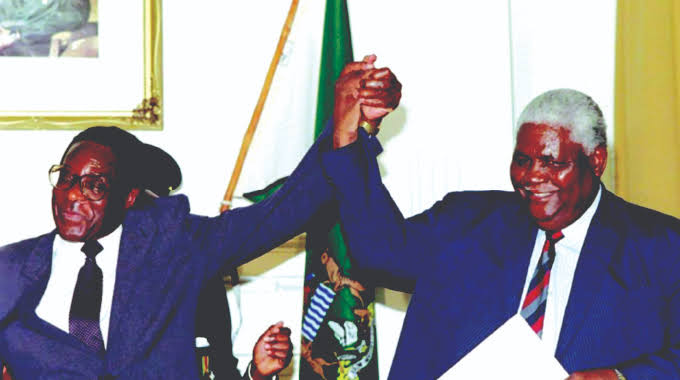
The Unity Accord, signed on December 22, 1987, between ZANU PF and PF ZAPU, was supposed to symbolize national healing.
A handshake between Robert Mugabe and Joshua Nkomo, two giants of Zimbabwe’s political history, was supposed to mend the divisions.
But to be honest True Patriots, after the Liberation War, Mugabe didn’t just want peace; he wanted control.
That is why the world witnessed one of the darker moments in our country’s post independence history the Gukurahundi genocide.
A genocide designed not only to eliminate perceived threats but also to wipe out any opposition, regardless of how much it cost in human lives.
And just in case we forget the true cost of this “unity,” let’s remember that Nkomo, in 1985, had to flee the country disguised in women’s clothes, a desperate move to avoid arrest or execution. “Unity” in the face of such cruelty? Well, that’s like calling a band-aid a cure for a broken leg.
Unity Day used to have a purpose, however grim its origins.
It was meant to signify peace after great suffering.
Today, though, under the so-called “Second Republic,” it has been reduced to a hollow ritual.
The “unity” on display is nothing but a political slogan, trotted out when the government needs to pretend like it’s actually doing something for the country.
What we really need, however, is a reckoning—a true process of healing for a nation still scarred by its past.
But it’s hard to heal when the people in power are more interested in making backroom deals with shady businessmen than addressing the real issues.
Ruka Chivende, the man handed the impossible task of actually unifying this fractured country, seems more invested in securing his own power than repairing the damage.
With his cozy relationships with fraudsters and shady elites, the focus has shifted from rebuilding the nation to reinforcing the power of ZANU PF.
If Joshua Nkomo and Robert Mugabe were looking down, they would probably be furious at how the concept of “unity” has been hijacked.
What was once a call for healing has now become little more than a political tool for the powerful to hold on to control.
And as for the people of Matebeleland?
They’re still waiting.
Waiting for the promises made on that fateful day in 1987 to be more than just empty words. Waiting for development.
Waiting for justice. But instead, they’re left with a National Unity Day that serves the interests of the elite, while the wounds of the past remain wide open.
Unity Day has become just another day for the powerful to pretend they’ve fixed what they’ve broken.
The rest of us True Patriots are still here, waiting for something that never truly comes.